
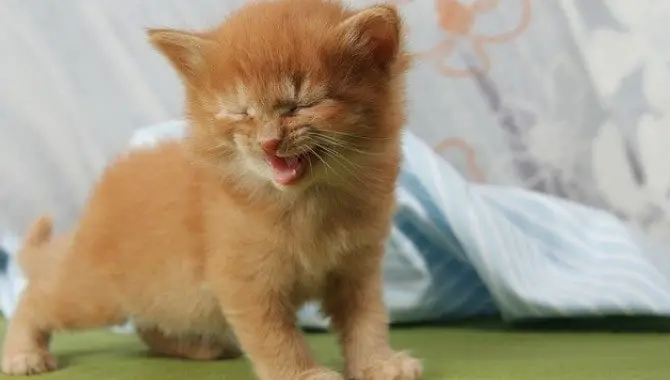
If you have ever had a cat as a pet you know that they have a wicked sense of humour for sure. I certainly have experienced their playfulness and mischievousness. However, that is not the question at hand. The question is whether cats are physically able to laugh. That is a question worth pondering. Scientific evidence is only beginning to show that animals do have emotions but the question of cats laughing is still a far-off notion. I have lived with a cat and though beliefs have nothing to do with the fact, I do believe that cats laugh.
Can cats laugh? The answer is far from certain. They do have a sense of humour and are very playful but laughter is very difficult to ascertain. There are physical manifestations of joy in cats that are similar to humans but serious comparisons are difficult to make.
The subject of cats laughing is not considered to be worthy of research. Those that question it are mostly content to continue on assumption. Observation seems to be the only way to evaluate if cats can smile or even laugh. since these are human manifestations, it is very difficult to know what the physical manifestations of animal emotions are. In this article, I will show that cats do indeed have expressions of joy and happiness that are similar to humans. Animal behavioural scientists are inconclusive but they do agree that cats and human body language are similar when showing emotion.
Do Cats Laugh?
As stated earlier, scientists have not yet proven that cats can laugh. However, based on observations many believe cats cannot smile or laugh. Feline behavioural scientists say that cats cannot smile because they have evolved their features to help them survive in the wild and the ability to smile is not going to help animals survive in the wild.
An animal behaviourist conducted a study to find out if dogs laugh and there was indeed swift and deep panting that resembled human laughter. When the same behaviourist conducted the test on cats, the closest cats came to laughter was purring and a silent, open mouth expression.
It is clear that saying that a cat can laugh is trying to give a human trait to an animal usually called anthropomorphizing. On the other hand, cats clearly do exhibit signs of joy and happiness expressed in the following ways:
Purring
A cat’s purring is an expression of a wide range of emotions. You can hear a cat purring from nearby or far away depending on the cat’s emotions.
Cats usually purr when they are happy and content. Contrarily, they can also purr when they are in pain or they want to sooth themselves.
Purring helps cats relax and stay calm whenever they are nervous or have some pent-up aggression. The type of purring will tell you what mood the cat is in.
You can also hear a cat purr when it is eating. I do think that a cat’s purring is the feline equivalent of a human smile. So, when you hear a cat’s purring it is because they are happy or they are nervous and are trying to calm down, just like humans.
Meowing
The closest feline expression is their meow. When cats meow, they are almost certainly happy.
However, you will need to consider the pitch of the meow to know the emotion the cat is feeling. A high pitched meow is usually an indication of happiness while a low pitched meow is an expression of sorrow.
I can attest that my cats do produce high pitched meows when they are in a playful mood.
Eyes
Just like a human, a cat’s eyes are the windows to their soul. If you want to know if a cat is happy you should look into their eyes.
If a cat is blinking slowly and has dilated pupils then it means that the cats feel comfortable in its surroundings or is happy. They will be a bright glean in a cat’s eyes if they are happy or satisfied. If the cat’s eyes are bright and he/she is also purring, then you have a purely blissful cat.
Playing
If your cat is in a playful mood then you can bet that it is happy. Just like humans, it is impossible to be playful and angry at the same time. The more playful your cat is, the happier it is.
I have had a lot of fun playing with my cats even though playtime with cats may involve scratching and biting. There is no pain without pleasure for cats.
Frequently Asked Questions
Do cats know when people laugh?
Just as we can recognize physical manifestations of happiness in animals, they can also recognize them in us. Animals do share similar characteristics when happy with animals such as dilated pupils, more rapid breathing and animated gestures among others.
Evidence that cats know when people laugh is that they will play with you whenever you are happy. Different human emotions have different energy frequencies and animals are better at sensing energies than people are.
Therefore, even if you are simply happy or feeling joy without actually laughing it is possible that your cat will be able to recognize it.
What sounds to cats produce when they are happy?
Cats are very silent creatures which are a characteristic they have developed to help them hunt and hence survive. Unlike the other popular human pet, dogs, you will rarely hear cats unless they are fighting or mating.
Cats mainly produce two types of sounds when they are happy namely purring and meowing. You will hardly ever hear any other sounds from a cat.
Purring is the more common of the sounds produced by cats. However, cats do not purr only when they are happy. They will purr based on the emotion they are currently feeling. If you pay close attention to the purring of a cat, you can guess what state it is in.
If a cat is purring deeply and aggressively, then it is in a foul mood. Contrarily if its purring is soft and relaxed, then the cat is happy and satisfied.
As far as mowing is concerned, the pitch of the meow will signal the cat’s mood. When a cat is happy it will often meow in a high pitched tone repeatedly.
Do cats produce any other sounds than meowing and purring?
Purring and meowing are the two common sounds you will hear from a cat but they are not the only ones. Cats also produce other sounds that are harder to categorize.
One example is the sound a cat produces when you tickle its belly. Though the sounds are surely sounds of pleasure, they cannot be clearly labelled as meows or purrs.
I have also heard my cat produce weird sounds especially when playing. These are the sounds that are eerily similar to human laughter. The sounds are very much like a sharp scoff. You can hear such sounds when a cat is playing with a ball and string or